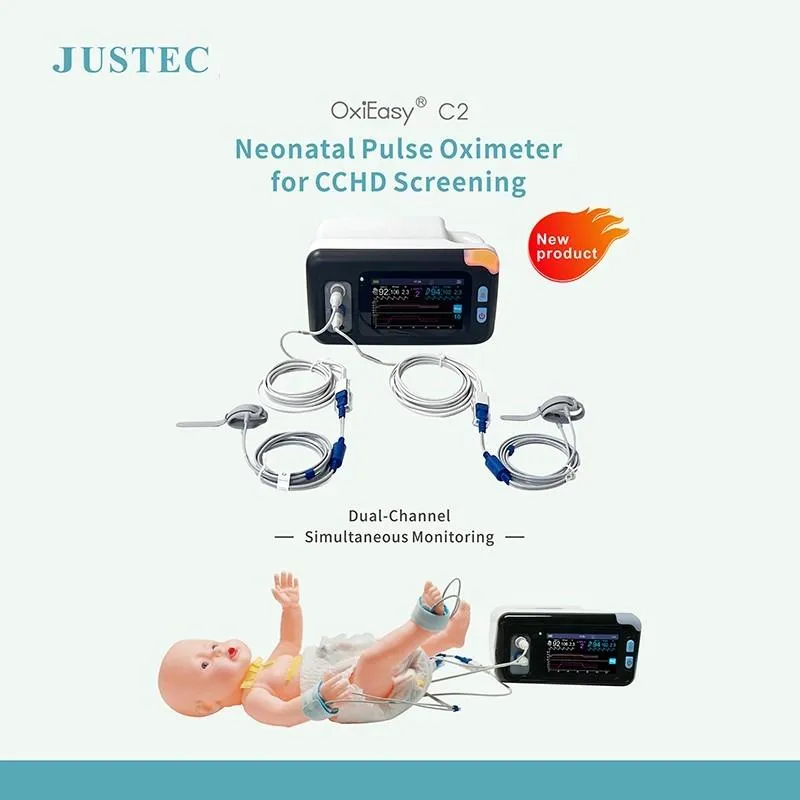
CCHD Oximeter (Pulse oximeter for neonatal Critical Congenital Heart Disease examination)
Equipment
Information
Dual-channel high-performance SpO2 measurement with real-time signal display improves the accuracy of CCHD screening and eliminates missed detections.
Critical Congenital Heart Disease (CCHD) refers to severe heart defects present at birth that require intervention within the first year of life. Affecting roughly 18 per 10,000 births in USA, these conditions cause low oxygen levels and, if undetected, can lead to fatal shock or collapse. Early detection via newborn pulse oximetry screening is crucial for prompt treatment.
Core Theoretical Principles
Pre- and Post-ductal Comparison: The screen measures SpO2 in the right hand (pre-ductal, reflects blood from the heart before the ductus arteriosus) and either foot (post-ductal, reflects blood after the ductus arteriosus). A significant difference (>3%) or low absolute reading (e.g., <90% or <95%) helps identify structural defects that cause left-to-right or right-to-left shunting.
The 95% Cutoff Threshold: According to American Academy of Pediatrics (AAP) guidelines, a passing screen is an SpO2 of $\geq$95% in the right hand or foot with $\leq$3% difference between them.